
Procedure
Shock Wave Therapy
Shock wave therapy delivers focused acoustic pulses to damaged tendons and soft tissue to stimulate healing and reduce chronic pain in tendon and joint conditions.
Book a consultation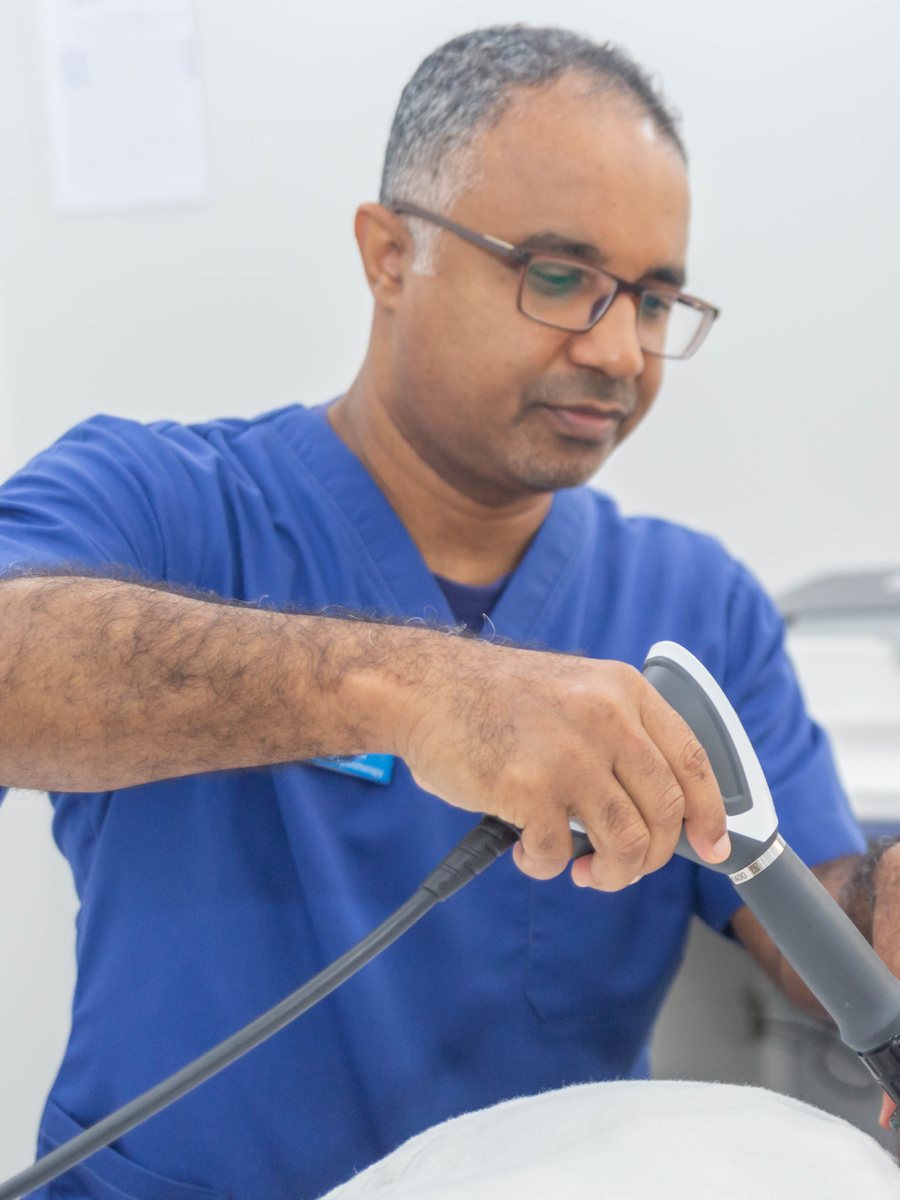
What is Shock Wave Therapy?
Extracorporeal shock wave therapy (ESWT) uses a handheld probe to deliver high-energy acoustic pressure waves into the body through the skin. These are not electrical shocks: they are mechanical pressure waves, similar in nature to ultrasound but far higher in energy. Two delivery systems exist. Radial shock wave therapy produces diverging pressure waves that spread outward from the applicator tip, suited to larger, more superficial areas. Focused shock wave therapy concentrates the energy at a precise depth, useful for deeper structures like the hip tendons or calcific deposits in the shoulder.
The waves produce microtrauma at the target tissue, which reactivates a healing response in tissue that has become chronically degenerated and poorly vascularised. They also break down calcific deposits by disrupting the calcium crystal structure, and they hyperstimulate local pain receptors in a way that down-regulates their sensitivity over time, reducing chronic pain independent of the tissue repair effect.
What conditions does it treat?
Chronic tendinopathy is the primary indication: tennis elbow (lateral epicondylitis), plantar fasciitis, patellar tendinopathy, and calcific rotator cuff tendinitis all have strong evidence for ESWT. These are conditions where the tendon has failed to heal normally and conservative measures like physiotherapy and anti-inflammatory treatment have provided incomplete relief. ESWT is particularly useful as an alternative to corticosteroid injection in tendon conditions where repeated steroid can weaken the tendon over time.
What to expect
Before: No special preparation is needed. Avoid anti-inflammatory medications (ibuprofen, naproxen) for two to three weeks before and after treatment, as inflammation is part of the healing response ESWT is trying to stimulate. Tell us if you have a pacemaker or blood clotting disorder.
During: Ultrasound gel is applied to the skin and the probe is pressed firmly against the treatment area. Most patients feel a tapping or thudding sensation, sometimes quite intense over the most tender spots. A session lasts 10 to 20 minutes. Three to five sessions are typically needed, spaced one week apart.
After: The treated area may be sore for 24 to 72 hours after each session. This is expected and reflects the therapeutic response. Avoid anti-inflammatory medication during the treatment course. Improvement is gradual: most patients notice significant change after the third session, with full benefit apparent at 6 to 12 weeks.
Conditions this treats
Related services





Tell us what's hurting.
One consultation. One coordinated team. A plan built around your case.